Interoperability and Trust Key to AI Commerce: Alipay+ and S&P Global Report
Report shows consumers expect mobile wallets to evolve beyond payments into integrated platforms for travel, rewards, commerce and AI-powered services
Cross-border payments remain fragmented with more than half of consumers lacking access to preferred payment and facing uncertainty over payment acceptance
AI adoption is accelerating across discovery and planning, but 43% express privacy concerns, and strengthening trust needed to scale AI-enabled commerce
A new report by Alipay+, the unified wallet gateway of Ant International, in partnership with S&P Global, reveals a growing "commerce digitalisation gap", with people increasingly expecting seamless mobile payments and intelligent digital assistance, yet friction – from inconsistent payment acceptance to trust in AI – still define their experience.
The study, which surveyed 6,000 consumers across nine markets in Asia, Europe and the US on their cross-border spending habits, points to a major shift underway in global commerce — one where e-wallets, AI and interoperable digital ecosystems are becoming foundational to how consumers discover, transact and engage across borders.
Key findings:
- Travel exposes gaps in global commerce infrastructure: More than half of consumers cite uncertainty around merchant acceptance (53%) or lack of access to preferred payment methods (54%), leading one in four to still carry cash as a fallback.
- Shift to hyper-local, high-frequency spending highlights need for localised payment acceptance: Food and beverage (67%) and local attractions (66%) now see the largest increase in traveller spending, with more than half of consumers (54%) spending more at local shops and eateries than malls or chain restaurants.
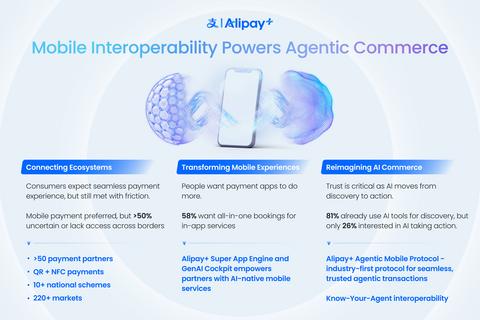
- Consumers want payment apps to do more: Restaurant reservations (61%), all-in-one booking (58%), and attraction access (57%) emerged as the most in-demand in-app services globally.
- AI adoption stronger for exploration than action: While 81% already use AI tools for travel discovery and planning, consumers become more selective as AI moves closer to bookings, refunds and payments.
- Trust critical to agentic commerce: Global privacy concerns remain high at 43%, reinforcing need for trusted platforms within consumers’ daily behaviours.
“The world has already become mobile-first and borderless, and the challenge now is whether commerce infrastructure can evolve quickly enough to keep pace with consumer expectations,” said Douglas Feagin, President of Ant International. “The next phase of global commerce will not be defined by whether payments are digital, but whether ecosystems are intelligent, interoperable and globally connected.”
Interoperability foundational to cross-border commerce
Consumers are moving fluidly between e-wallets, cards, QR codes and NFC-based payment ecosystems across borders. Yet the travel journey remains fragmented across local payment environments, creating growing friction between rising consumer expectations and existing commerce infrastructure.
Mobile payments are now the preferred method for everyday, in-destination spending for food, shopping and local attractions, while cards continue to dominate pre-trip bookings, particularly for those in Germany and the United States. Mobile payments, across both QR NFC, are also rapidly gaining traction, with 63% of consumers already using them for most transactions while travelling. Preferences, however, diverge across markets, with consumers from China, Malaysia and Thailand preferring QR payments, while those from the US, UK and Germany favour NFC-based, card-linked wallets.
Respondents who do not use digital payments express a clear intent to adopt them, saying they are either “very likely” (49%) or “somewhat likely” (51%) to use these methods on future trips.
This divergence is creating growing friction across the travel journey. More than half of consumers cite concerns around transaction security (62%), exchange rates and fees (56%), unfamiliar payment terminal steps (56%) and merchant acceptance (53%) when using mobile payments abroad. Friction also begins before consumers depart, with 54% reporting challenges using preferred payment methods during pre-trip bookings.
As a result, one in four still carry cash as a fallback, particularly among older consumers and in markets perceived as less interoperable.
Consumers are consolidating around integrated wallet ecosystems
Travel is accelerating the shift from payment apps into global-native wallet ecosystems, as consumers gravitate towards integrated platforms that combine discovery, booking, payments, rewards, and in-destination services within a single experience.
This shift is being driven by growing complexity across the travel journey itself. Consumers increasingly cite overwhelming choices, fragmented booking platforms and lack of destination-specific guidance as major frustrations when planning travel. At the same time, rewards and cashback (52%), better FX rates (51%) and expense tracking (50%) rank among the strongest drivers of wallet usage globally.
Demand for integrated in-app travel services is also accelerating, with consumers expressing strong interest in restaurant reservations and payments (61%), all-in-one travel booking (58%), attraction tickets and passes (57%), and local transportation booking (54%).
Expectations, however, vary across markets. Consumers from China, Thailand, Malaysia and Singapore show stronger demand for integrated experiences within a single app, while those in Japan and Germany prioritise security, transparency and predictable payment experiences.
AI is trusted for advice, but not yet for action
AI adoption is accelerating rapidly, with 81.3% of consumers already using AI-powered tools to explore destinations and experiences. However, adoption becomes more selective as AI moves from exploration to action.
While 73.2% of consumers are open to using AI for hotel or flight bookings over the next 12 months, confidence declines as AI moves closer to payments and autonomous decision-making, with only 26% of consumers stating interest in doing so.
Yet, openness towards AI-enabled commerce remains strong, particularly in markets such as China, Malaysia and Thailand. When asked about using an AI travel assistant during their trip, 87.7% of global consumers said they value AI-supported bookings and re-bookings, AI-assisted payments and refunds (86.9%), and real-time travel guidance and support (84.6%).
The gap between AI discovery and execution ultimately comes down to trust and control. Privacy concerns remain high globally (43%), while two in five consumers (43%) say they hesitate to use AI assistants because they prefer planning travel themselves, and a third (32%) citing a preference for human advice.
“The opportunity lies in embedding AI securely within trusted ecosystems, allowing consumers to act on intent more seamlessly while retaining trust and user control across the commerce journey,” added Feagin.
Building the foundations for agentic commerce
As consumer behaviours become increasingly digital and mobile-first, payment apps are the natural convergence point for commerce, rewards, and AI services. Ant International supports this shift through Alipay+, its unified wallet gateway that connects 2 billion user accounts across 50 global payment partners to merchants in more than 220 destination markets utilizing both QR and NFC. Alipay+ also partners with more than 10 national payment schemes across Asia and beyond, supporting inclusive payments and growth for millions of small local merchants.
To help build the next era of AI commerce, Ant International has introduced a growing suite of interoperable and AI-powered solutions designed to help wallet partners evolve into integrated mobile ecosystems. This includes the Alipay+ Agentic Mobile Protocol (AMP), the world’s first open-source framework for agentic payments for mobile devices, alongside the Alipay+ Super App Engine (ASAP 2.0), GenAI Cockpit and Voyager AI travel agent, empowering partners to build AI-native solutions for their users.
About Alipay+
Ant International's Alipay+ is a unified wallet gateway with cross-border payment and digitisation services that help connect global merchants to consumers. Consumers enjoy seamless payment, a broad choice of deals and the convenience of digital services using their preferred payment app while travelling abroad. Small and medium-sized businesses may use Alipay+ digital tools to enhance efficiency and achieve omni-channel growth.
Contacts
Media Contact:
Ant International PR
pr@ant-intl.com

- 马爹利全新品牌代言人林更新携新年限量礼盒献礼农历马年
- CHAT高考APP:助力中国考生实现精准志愿填报
- HistoSonics完成首批患者治疗,以评估Edison®组织碎化系统在治疗良性前列腺增生(BPH)中的应用
- 2024年全球招商|选择天时地利人和的长隆万博,实现互利共赢的“双向奔赴”
- 让清洁不再是伤害,DauggeKemmi它博会官宣pH6.5宠物皮肤科学养护新概念
- HCL Group携手UpLink发布第四届全球Aquapreneur创新挑战,以增强水资源韧性
- (第七届进博会)联合利华大中华区总裁:中国具有全球竞争力的开放创新生态
- 喜宴果汁第一品牌“桃花开”荣获“2025品牌影响力发展大会”多项殊荣
- 被误解太久的无代码:为什么它比低代码更适合构建复杂企业系统
- 靖工匠CK Artisans官方授权公示:广州馨潇贸易为中国大陆合规Ledger硬件设备服务商
- 福建漆宝斋与世界品牌丹拿至尊大漆系列作品在广州成功发布
- 电子签名行业唯一独角兽:e签宝荣登《世界独角兽企业发展报告2025》
- UPS推出改变游戏规则的UPS® Global Checkout:跨境购物再无意外进口费用
- 蒙商扬帆出海,共谋发展机遇——内蒙古自治区促进民营经济发展项目之马来西亚、泰国商业交流
- 金融街物业宣布2024年度业绩 经营效益稳步向好 总营收超17亿人民币
- Andersen Global新增巴西成员公司,强化法律服务能力
- 王子璇领衔话剧《三姐妹》圆满成功,演绎经典作品绽放璀璨光芒
- 天缘家甄选:传递美好滋味的使者
- 中国人寿财险株洲中支积极开展清廉金融文化建设
- 菜百股份受邀出席 2025 “寻找老字号消费力”沙龙
- “琴澳一体”加速:横琴户籍优势下的资产配置新逻辑
- TrumeterAPM-PWR-APO功率表
- Apollomics Announces Continued Listing on The Nasdaq Stock Market Following Hearing Cancellation
- Sportradar Secures Major Client Wins on Strength of Managed Trading Services
- 抓服务 促提升 临商银行北京路支行开展优质服务专项培训
- Regnology Launches RRH Ascend, Leveraging Straight-Through Reporting to Modernize Financial Regulati
- 四针状氧化锌晶须:航天抗菌“转战”家居健康战场
- 智盛甄选:开启智慧电商新篇章,助力品质生活
- Cedo收购Plasta Group
- 中建西部建设集团第一有限公司武侯厂、双流厂召开2025年党的建设工作会、工作会暨职工代表大会